
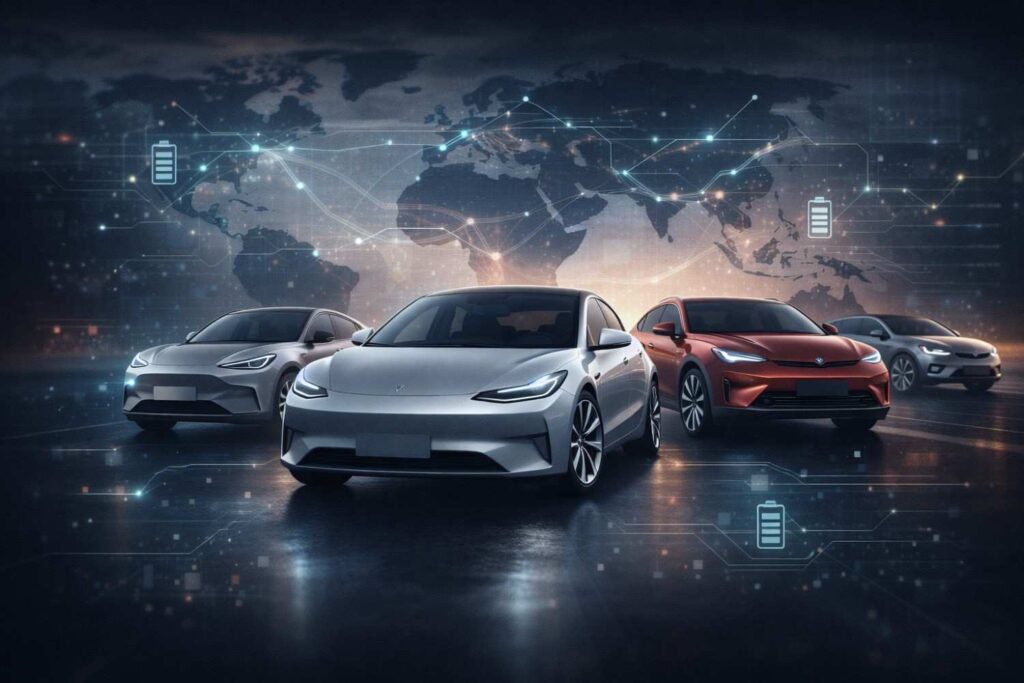
Chinese EV brands are no longer a future threat—they are a present force reshaping the global electric vehicle market in 2026. Once seen primarily as domestic players serving China’s massive internal demand, these companies are now expanding aggressively into Europe, Asia, Latin America, and emerging markets.
With competitive pricing, rapid innovation cycles, and unmatched manufacturing scale, Chinese EV brands are challenging long-established automakers and redefining what global competition in electric mobility looks like. This shift is not theoretical—it is already visible in sales data, export volumes, and pricing pressure worldwide.What Happened: Chinese EV Brands Moved From Domestic Dominance to Global Expansion
The disruption caused by Chinese EV brands accelerated when domestic success translated into export readiness. After years of policy support, infrastructure investment, and supply-chain localization, Chinese automakers reached a scale that allowed them to compete globally. As demand growth in China stabilized, brands turned outward. Europe became the first major testing ground, followed by Southeast Asia, the Middle East, and parts of Latin America. The global EV market entered a new competitive phase almost overnight. (Source: https://www.reuters.com/world/china/china-ev-exports)Key Details: Why Chinese EV Brands Are So Competitive
Chinese EV brands combine cost efficiency with speed—an advantage few competitors can match. Key competitive strengths include:-
- Large-scale battery manufacturing
-
- Vertically integrated supply chains
-
- Faster product refresh cycles
-
- Aggressive pricing strategies
-
- Strong domestic EV ecosystem
Why It Matters: The Global EV Market Is Being Repriced
The rise of Chinese EV brands matters because it changes the economics of electric vehicles globally. Affordable pricing forces competitors to respond—either by cutting margins, delaying EV rollouts, or accelerating cost reduction. For consumers, this means faster adoption and better value. For automakers, it means intensified competition and shrinking room for inefficiency. The global EV market is no longer protected by legacy brand power alone. (Source: https://www.weforum.org/agenda/electric-vehicles)Market Perspective: A Structural Shift, Not a Temporary Trend
From a market perspective, Chinese EV brands represent a structural shift rather than a cyclical trend. Their success is rooted in manufacturing scale, battery access, and domestic volume that de-risks innovation. Unlike startups that rely on external funding, many Chinese automakers operate profitably at scale, allowing sustained global expansion even during pricing pressure. (Source: https://www.statista.com/markets/electric-vehicles)How BYD Became a Global EV Powerhouse, BYD Globale expansion:-
BYD stands at the center of the Chinese EV brand disruption. With control over batteries, power electronics, and vehicle assembly, BYD operates one of the most vertically integrated EV models in the world. Its global expansion strategy focuses on affordability, reliability, and fleet adoption—making it a serious competitor to established EV leaders. BYD’s rise illustrates how Chinese EV brands convert scale into global influence. (Source: https://www.bydglobal.com)Technology and Batteries: China’s Hidden Advantage
Battery technology is the foundation of EV competitiveness, and Chinese EV brands hold a critical advantage here. China dominates battery production, raw material processing, and next-generation chemistry deployment. This battery leadership enables lower costs, stable supply, and faster innovation cycles—advantages that compound over time. (Source: https://www.bloomberg.com/energy/batteries)Expert View: Why Analysts Take Chinese EV Brands Seriously
Automotive and energy analysts increasingly view Chinese EV brands as long-term global competitors rather than regional players. Experts point to manufacturing discipline, cost curves, and export momentum as indicators of sustained disruption. Analysts at global institutions note that ignoring Chinese EV brands now would repeat mistakes made during earlier industrial shifts. (Source: https://www.imf.org/en/Topics/climate-change)Global Trade and Policy: The Pushback Begins
As Chinese EV brands expand, regulatory scrutiny is increasing. Trade investigations, tariff discussions, and localization requirements are becoming part of the global response. However, policy barriers may slow—but not stop—the momentum. Competitive pricing and demand for affordable EVs continue to drive market entry.What’s Next: How Chinese EV Brands Will Expand Further
Looking ahead, Chinese EV brands are expected to:-
- Localize manufacturing in key markets
-
- Partner with regional distributors
-
- Expand into commercial and fleet EVs
-
- Invest in software and AI-driven features
Challenges: Risks That Could Slow the Disruption
Despite momentum, Chinese EV brands face challenges:-
- Geopolitical tensions
-
- Regulatory uncertainty
-
- Brand trust in premium segments
-
- After-sales service scaling